
The importance of "WHY"

One of the first questions a potential client expects to be asked by an architect is “What style do you like?” We’re a little different. My first question, regardless of the project type, is “WHY” do you want to do this?”
The answer of the speculative developer is going to be very different from that of a couple with a large family, or that of a couple who want to age gracefully in place. At the end of the day, that one-word question “WHY" is repeated over and over again through the process. WHY do you want 12 bedrooms and 14 bathrooms? WHY do you want an exterior kitchen? WHY do you want a secondary kitchen behind the main kitchen?
Asking WHY allows us to focus on function over form (style). More importantly, It also helps us get to a deeper understanding of our clients and their motivations. Do they have a formal or casual lifestyle? Do they entertain a lot or look at their home as a place of escape? Style can be added and often comes about as a secondary response to the form created by the function.
Functionally, homes are reflections of their time period and a continual evolution of lifestyles. Over the decades of my career, I‘ve watched the emergence of a more casual plan combining living, cooking, and dining in one gathering spot. This was a reaction to the more formal plans lingering from a time when even middle-class households had staff come in to cook and clean. In those days, there were formal rooms for entertaining guests, and the kitchen was a small utilitarian space for the preparation of meals. It also tended to include a small sitting area. At the moment, those living and dining rooms are unfortunately out of vogue. The living room has shrunk to become a flex room that could be a home office or guest room. In many cases, the dining room has totally disappeared.
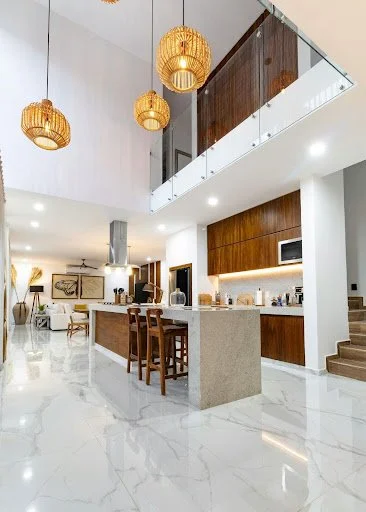
During the 1980’s, 2 story great rooms became a must-have. They are found in almost every subdivision plan of the period through today. They often included a second-story balcony overlooking the space. What you ended up with were large rooms filled with echoes and tall blank walls. The scale was off. The primary view seen through a window wall was typically a patio or deck accessed through that room. What is often forgotten is that those windows frequently need sun control of some sort. Unless the landscape outside of those windows is lit at night, they also become black mirrors.
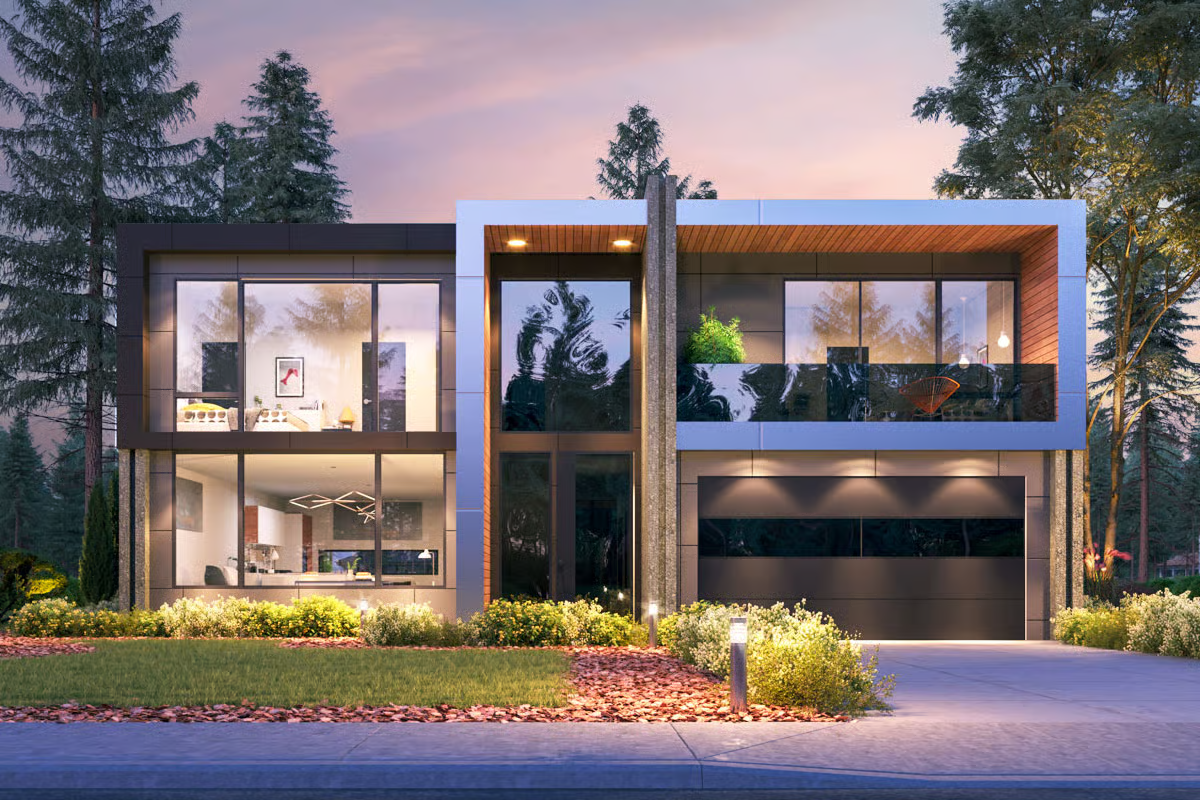
If that space opens toward the street, you end up living in a giant fishbowl. The fishbowl effect can be handled through creative landscaping to maintain privacy. With night lighting, it can provide a view from the interior while screening the view of the interior. This brings us to the more challenging part of a design- the delineation of private vs. public space. One of the more challenging pieces of the puzzle to lock down is the location of the powder room. While I typically say never say never, one of my ironclad rules is to locate a powder room in a discrete area, where a guest can feel that they are not announcing its use to the entire household.
Echoes and noise can also create an issue for those 2 story great room spaces, as noise migration will impact sleeping areas on the second story. We can often use closets and other storage spaces to buffer noise transmission from one room to the next. Using acoustic insulation is another trick of the trade. And please make sure your plumbing drops are insulated so your guests don’t hear the walls gurgling from above!
Understanding that a client wants the master on the upper floor with the kids’ rooms when they are young will often shift once they become empty nesters with bad knees is important and something to discuss during the process. There may need accommodation for an elevator. A more recent trend is the multigenerational household. How do you manage an older parent or in-law in your home while giving both you and them the privacy and dignity they deserve? It’s all a balancing act and comes back to how a client answers the question “WHY”.
WHY? Ultimately, because every client is different and comes with their own dreams and desires. You have security-conscious collectors of books and art. You have very active clients for whom working out, athletics, and comfort take center stage. You have wine connoisseurs who entertain frequently. You have those who want to retreat from the city in their own oasis and others who want to show the world what they have. You have artists and musicians, lawyers and doctors. Every single one is different. Helping these very individual clients achieve their goals is the “WHY” for us. We have a myriad of tools and ideas that we bring to the table to serve our clients. In our world, one size never fits all.
Helping each and every one of our unique clients achieve their property dreams and aspirations isn’t just what we do, it’s WHY we do it.